Section 4.2

Bayesian Text Classification:
The Naive Approach

Discover the elegance, simplicity, and efficiency of a probabilistic classifier that ingeniously applies 18th-century mathematics to modern AI.

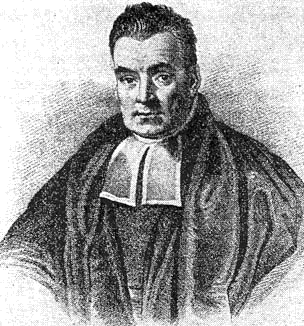
Thomas Bayes

Thomas Bayes

c. 1701-1761

The Man Behind The Math

An English statistician, philosopher, and Presbyterian minister. His most notable contribution, Bayes' Theorem, was presented posthumously to the Royal Society in 1763.

"A fundamental concept in probability theory that describes the probability of an event based on prior knowledge of conditions related to it."

The Intuition

Why "Naive"? The Candy Mystery

Imagine you are a detective trying to identify a candy based on three clues.

Clue 1: Color

The candy is Red.

Clue 2: Shape

The candy is Round.

Clue 3: Size

The candy is Small.

The "Naive" Assumption

It's called "Naive" because it assumes these clues are independent. It calculates the probability based on each clue separately, ignoring that red candies might usually be round.

Verdict: Cherry Gummy
Under the Hood

The Mathematics

Bayes' Theorem

P(A|B) =
P(B|A) × P(A) P(B)
Posterior = (Likelihood × Prior) / Evidence
1

The Prior P(A)

We start with an idea of how common "Fairy Tales" are in our library. If 90% of our books are fairy tales, we start with a strong guess.

2

The Likelihood P(B|A)

We look at words (features) like "Magic", "Dragon", "Princess". We calculate: Given it is a fairy tale, how likely is it to see the word 'Dragon'?

Variants of Naive Bayes

Multinomial

Akin to a word-counting strategy. It cares about frequency. If "magic" appears 10 times, it's a super clue.

Best for Text Classification
Best for Spam Filtering

Gaussian

Tailored for continuous data (e.g., weight, height). Assumes data follows a Bell Curve (Normal Distribution).

Best for Numerical Data
Best for Real-valued attributes

Limitations & Challenges

The Continuous Variable Conundrum
Gaussian Naive Bayes assumes a bell-curve. If real data looks like a rollercoaster (erratic distribution), the model's predictions will be inaccurate.
Knowledge Gaps (Independence)
Language has structure. "San" and "Francisco" are not independent. Naive Bayes ignores these dependencies, which can lead to errors in complex contexts.
The Power of Prior Knowledge
If the training data (Prior) is outdated, the model fails. For example, if it believes 99% of books are fairy tales, it will likely misclassify a new sci-fi book as a fairy tale.

Knowledge Check

Which variant of Naive Bayes focuses on word frequency counts?